

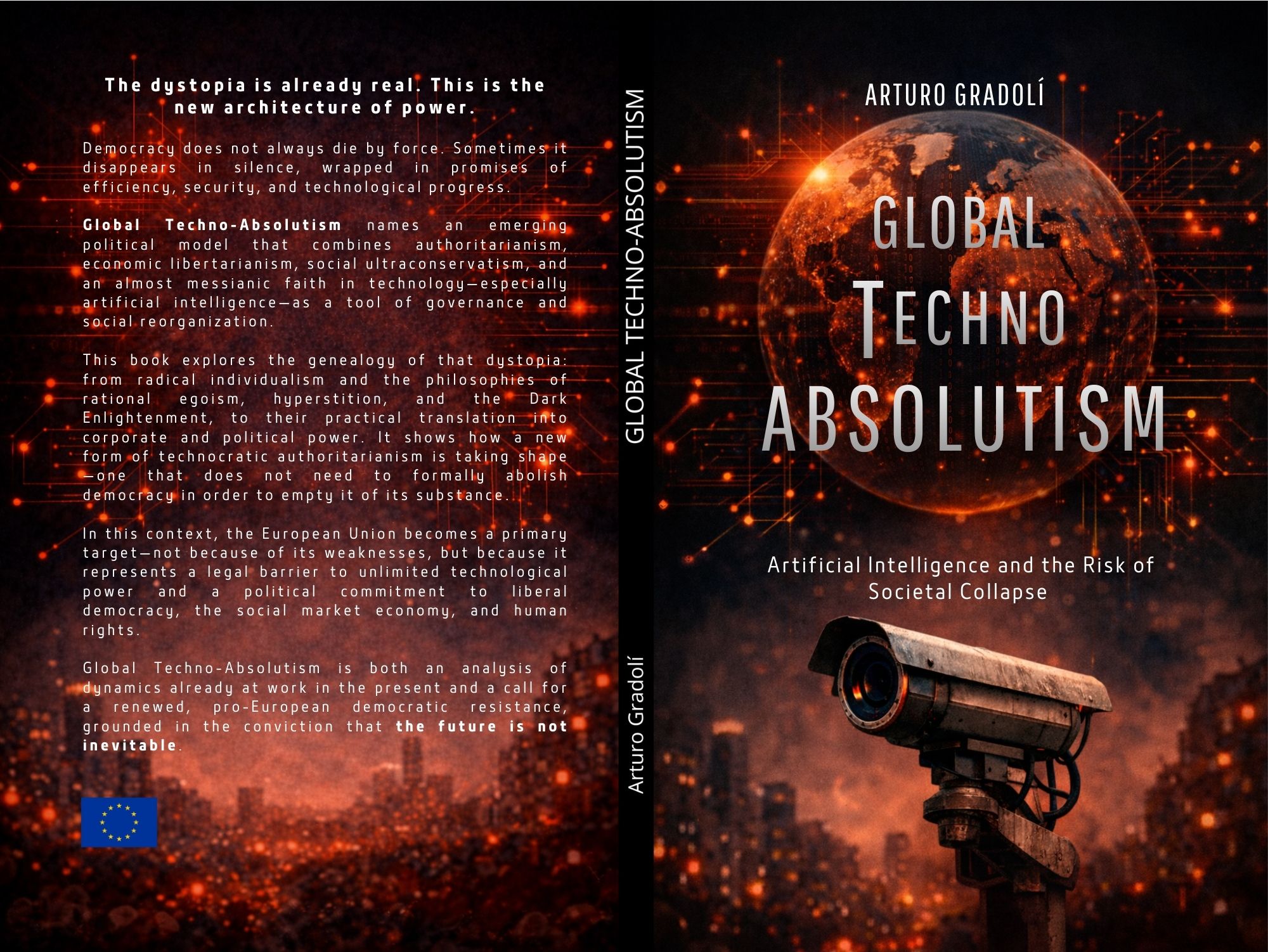

Democracy does not always die by force. Sometimes it disappears in silence, wrapped in promises of efficiency, security, and technological progress.
When we speak of absolutism, the 17th and 18th centuries come to mind. We think of Louis XIV declaring, L’État, c’est moi — “I am the State.”
That was the absolute concentration of power: without limits, without counterpowers, without representation of citizens in parliaments.
What I propose is that we are entering a new form of absolutism. But it no longer bears the face of an absolutist monarch.
Under Global Techno-Absolutism, technocratic elites with enormous economic resources and decision-making capacity now concentrate power in artificial intelligence technologies and social networks. If in the past the king could say, “I am the State,” now we might say, “Algorithms decide for everyone.”
Global Techno-Absolutism names an emerging political model that brings together authoritarianism, economic libertarianism, social ultraconservatism, and an almost messianic faith in technology—especially artificial intelligence—as a tool of governance and social re-engineering.
The book explores the genealogy of this dystopia: from radical individualism and the philosophies of rational egoism, hyperstition, and the Dark Enlightenment to their practical translation into corporate and political power. It shows how a form of technocratic authoritarianism is emerging that does not need to formally abolish democracy to empty it of substance.
In this context, the European Union becomes a primary target—not because of its weaknesses, but because it represents a legal brake on unchecked technological power and a commitment to liberal democracy, the social market economy, and human rights.
Global Techno-Absolutism is a study of dynamics already operating in the present and, at the same time, a call for pro-European democratic resistance, grounded in the conviction that the future is not inevitable.

